The way security teams interact with vulnerability data is changing.
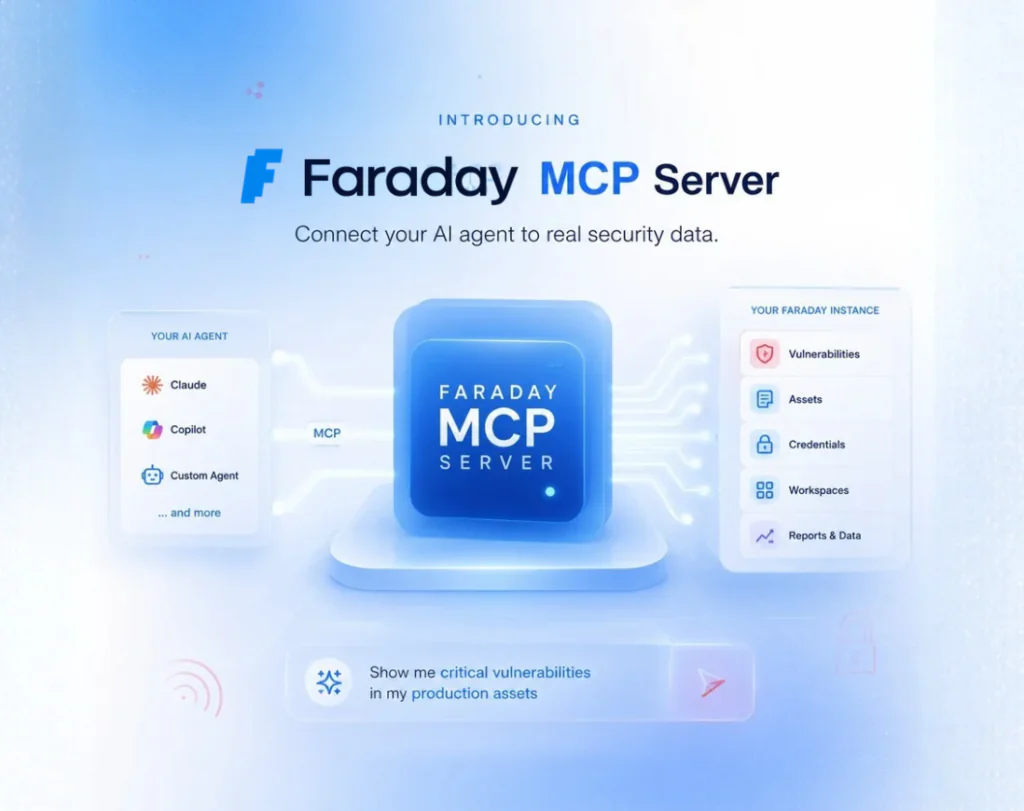
With the introduction of Faraday’s Model Context Protocol (MCP) server in version 5.20.1 and the refinements included in Release 5.21, security teams can now connect their preferred AI agents directly to Faraday platform and start interacting with their vulnerability data using natural language.
This release also delivers improvements across security, performance, and workflow automation, helping teams manage growing volumes of security information more efficiently.
Highlights
Bring Your AI Agent or LLM model to Faraday.
Bulk Import of Leaked Credentials
Stronger Security Across the Platform
Faster Performance Where It Matters
Better Visibility and Consistency
Bring Your AI Agent or LLM model to Faraday.
Our MCP (Model Context Protocol) server, allows organizations to securely connect AI agents like Copilot or your own LLM model to their vulnerability management platform.
As AI agents become part of daily security operations, Faraday provides a structured and secure way to expose vulnerability data while maintaining the visibility and governance security teams require.
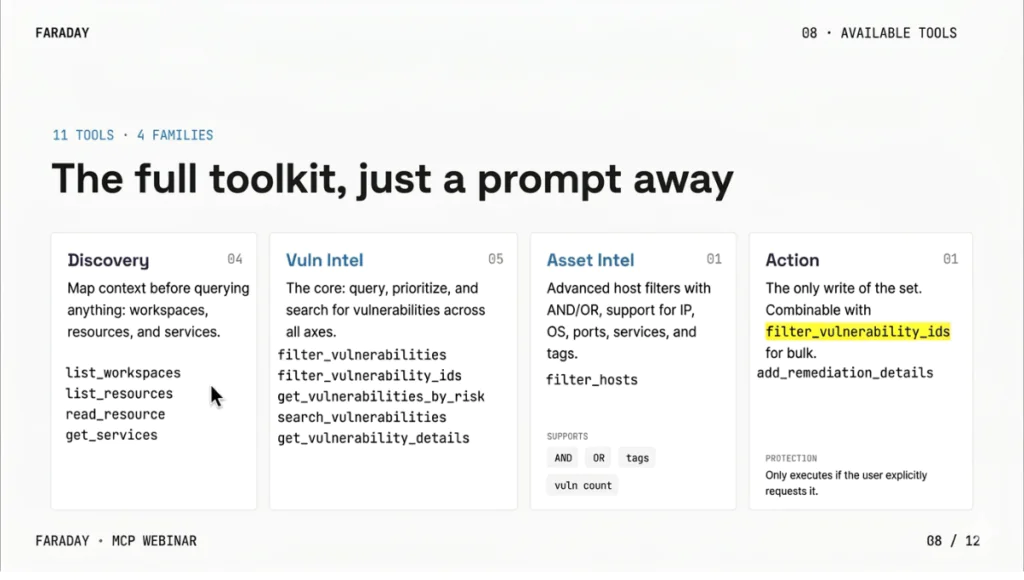
Instead of manually navigating dashboards, filters, reports, and bulk actions, users can interact with Faraday conversationally and ask questions such as:
- Show me all confirmed vulnerabilities in Workspace Project A.
- Which critical and high vulnerabilities are still open?
- Generate a report for confirmed, critical, open vulnerabilities in this workspace.
- Compare critical vulnerabilities across multiple workspaces.
- Which vulnerabilities have a Risk Score greater than 60 and require urgent remediation?
- Show me critical or high findings that have a known exploit available.
- Which assets are affected by the same vulnerability across different projects?
- Update the remediation text for a specific vulnerability.
- Generate an HTML report summarizing critical findings.
- Show me vulnerabilities associated with exposed credentials.
- Which findings remain unresolved after 30 days?
Beyond simple searches, AI agents can use Faraday’s context to retrieve vulnerability details, summarize findings, compare workspaces, generate reports, and even perform authorized updates directly from natural language instructions.
To simplify adoption, Faraday now includes an in-app setup guide that walks users through the entire configuration process, from connecting the MCP server to running their first queries.
Watch the Webinar
Want to see MCP and the new capabilities in action?
Watch the release webinar and learn how to connect Faraday to your preferred AI agent:
https://www.youtube.com/watch?v=55EfOCEejVA
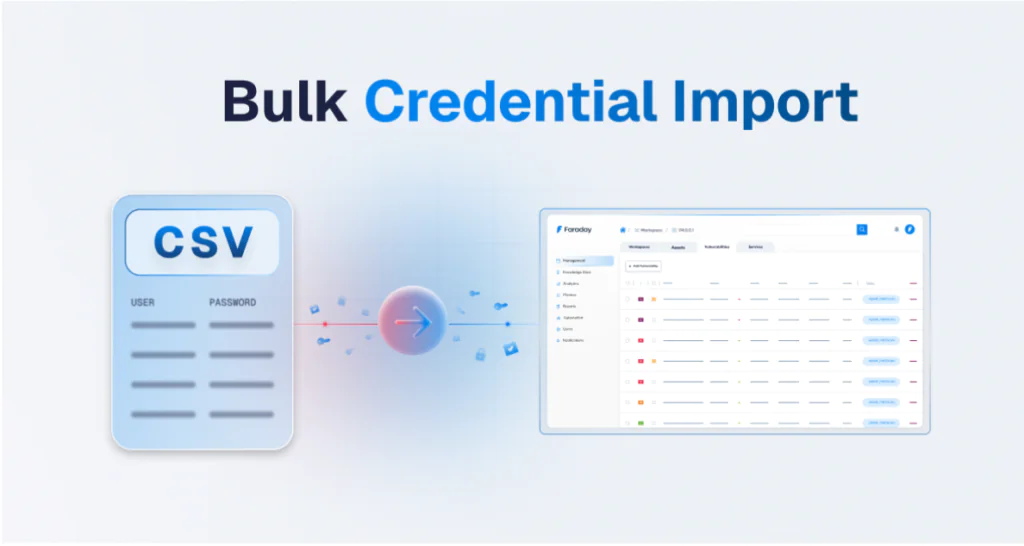
Bulk Import of Leaked Credentials
Organizations increasingly rely on red teams, threat intelligence providers, and credential exposure monitoring services to identify leaked credentials originating from public sources, breach datasets, dark web monitoring, or CTI feeds.
As part of a formal Vulnerability Management process, logging and tracking exposed credentials within a tool like Faraday Platform is a key step to move from a reactive incident response to a strategic risk management approach.
Although a leaked password is technically not a software flaw (like a buffer overflow), in modern vulnerability management, it represents a configuration exposure or an initial access vector that must be mitigated.
One of the most impactful additions in Release 5.21 is loading this finding into Faraday providing several critical advantages for the organization:
- Centralize credential exposure findings and correlate them with affected assets, services, and vulnerabilities.
- Prioritize remediation based on business context and asset criticality instead of treating all leaked credentials equally.
- Convert credential exposure into actionable remediation workflows through ownership assignment and ticketing integrations.
- Maintain a complete audit trail for compliance, investigations, and security reviews. Such as ISO 27001, PCI-DSS, or SOC2.
- Gain visibility into credential-related risk alongside traditional vulnerabilities through a unified security dashboard.
To support this capability, Faraday Plugins now include enhanced credential detection logic, automatically identifying credential datasets and importing them using the appropriate structure.
The result is faster ingestion, simpler integrations, and a more complete view of credential-related exposure across the organization.
For CISOs and security directors, Faraday consolidates all company weaknesses into a single dashboard. This makes it easy to track whether incidents involving exposed credentials are on the rise compared to traditional software vulnerabilities, helping leadership make strategic decisions
Stronger Security Across the Platform
Release 5.21 includes several security-focused improvements designed to strengthen platform resilience and protect sensitive information.
This includes:
- Security updates for multiple third-party dependencies affected by critical and high-severity CVEs.
- Fixes for vulnerabilities affecting filtering mechanisms that could potentially expose sensitive information.
- Additional protections for internal and non-sensitive endpoints.
- Improvements to authentication-related components and supporting libraries.
These updates help ensure that Faraday remains secure while organizations continue scaling their vulnerability management programs.
Faster Performance Where It Matters
This release also introduces backend and frontend optimizations focused on improving responsiveness for large deployments.
Key improvements include:
- Faster vulnerability table loading by requesting only the columns selected by users.
- Optimized workspace endpoints with significantly fewer database queries.
- Improved navigation transitions between dashboards and vulnerability views.
- Enhanced pipeline recovery mechanisms that automatically recover interrupted executions.
Together, these changes reduce loading times and improve the overall user experience for teams managing large volumes of findings.
Better Visibility and Consistency
Managing vulnerabilities requires access to the right information at the right time.
Release 5.21 standardizes Vulnerability data that has been normalized across the platform, making fields such as CVSS4, Risk Score, Impact, Description, Resolution, and Issue Tracker consistently available across tables, detail views, and filters. The result is a cleaner and more predictable experience when working with large datasets.
Professional and Corporate customers will also benefit from improved notification visibility, including workspace-aware notifications and better grouping for easier tracking.
Additional Improvements
Other notable enhancements included in this release:
- Renamed Agents to Runners and Cloud Agents to Security Scanners to avoid confusion with AI agents.
- New bulk delete endpoint for Runners.
- Improved Jira integration workflows.
- Better grouping and navigation experiences.
- Enhanced reporting support for CVSS4 fields in custom DOCX templates.
- Multiple stability fixes across analytics, notifications, pipelines, and workspace management.
Release 5.21 lays the foundation for that future while continuing to improve the security, performance, and reliability that organizations expect from Faraday.
Looking Ahead
The introduction of MCP is more than a new feature.
It represents a new way of interacting with vulnerability management platforms—one where security teams can leverage AI agents to explore, prioritize, report on, and remediate risk using natural language.
Your feedback continues to shape our roadmap. If you have questions or suggestions, contact us at support@faradaysec.com.
See you in the next release!
Documentation:
Homepage
Documentation
Download
Issue tracker and feedback
Frequently Asked Questions
Twitter