
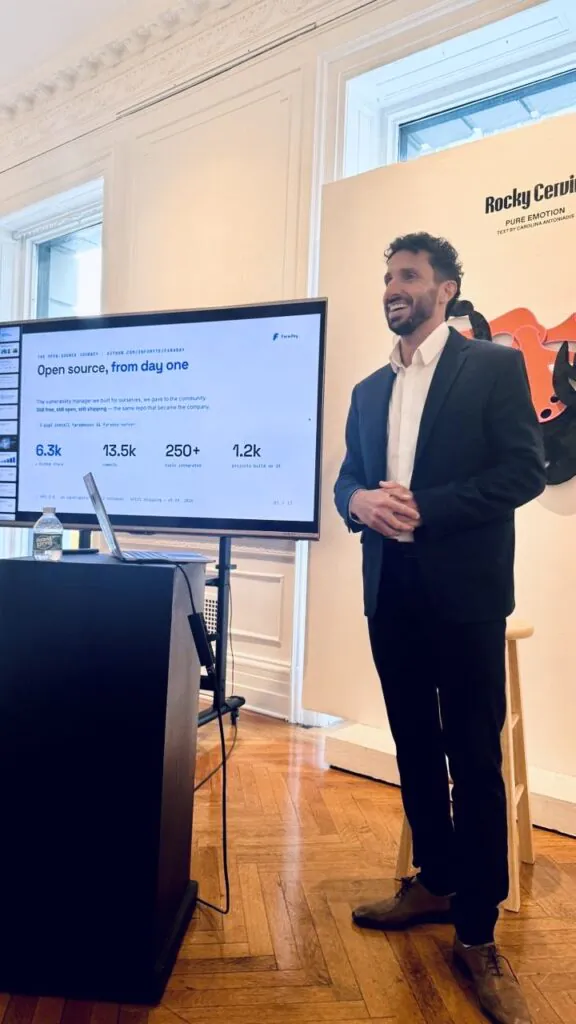
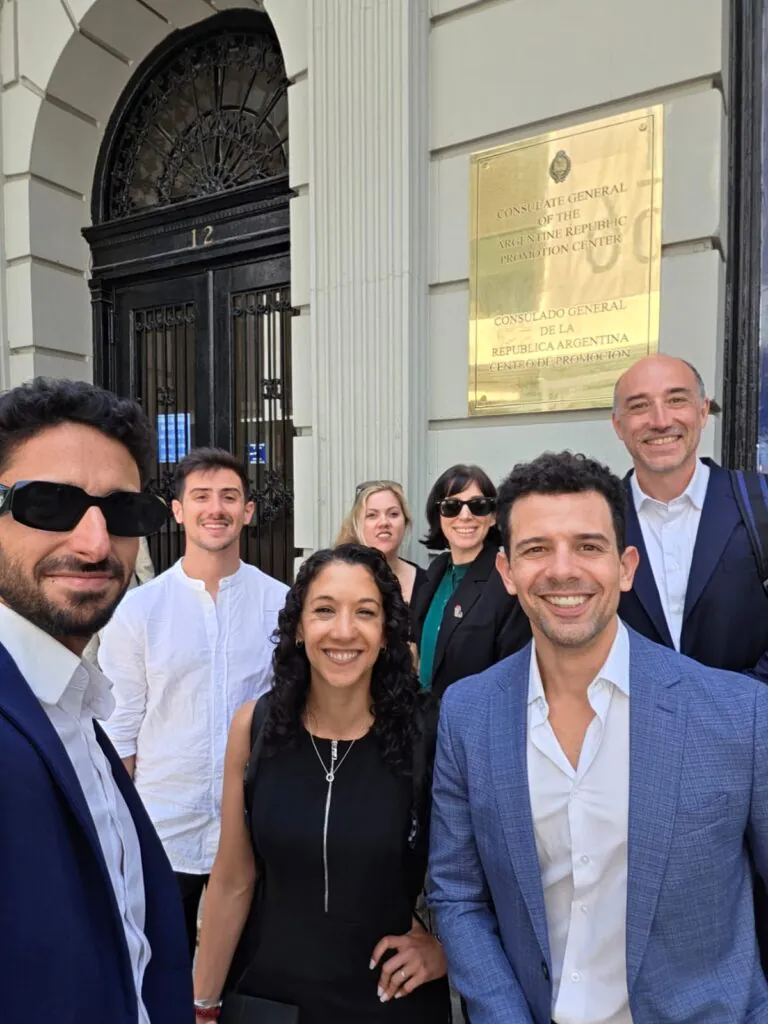
During New York Tech Week, Francisco Müller Amato, Co-Founder & Chairman of Faraday Security and Co-Founder of Ekoparty, joined a session hosted by Argentina Tech Hub at the Consulate General and Promotion Center of the Argentine Republic in New York.
His talk, “Built in Argentina: Autonomous Offense & Defense,” brought together technology leaders, entrepreneurs, and cybersecurity professionals to discuss how artificial intelligence is reshaping the future of cybersecurity.
For years, many organizations built their security programs around a familiar model: one or two penetration tests per year, continuous scanning, and remediation processes that often take weeks or even months to complete.
Attackers, however, no longer operate that way. Artificial intelligence and automation are accelerating reconnaissance, analysis, and exploitation activities, enabling attackers to identify opportunities at a pace that exceeds the response capabilities of many security teams.
The challenge is no longer simply finding vulnerabilities. It’s understanding which ones represent real risk and prioritizing them before an attacker does.
From Traditional Offensive Security to Autonomous Offensive Security
One of the central themes of the session was the evolution of offensive security.
If attackers can leverage automation and AI to scale their capabilities, defenders must adopt new ways to continuously validate risk, identify exposures, and generate actionable context.
Offensive security can no longer rely solely on periodic assessments. The future requires continuous, automated approaches capable of adapting to attack surfaces that change every day.
From Vulnerability Management to FaradAI
The session also explored Faraday’s evolution, from its roots in vulnerability management and offensive security to the development of FaradAI, Faraday’s technology for a new generation of AI-powered offensive security.
Beyond enabling natural language interaction with security data, FaradAI addresses one of the biggest challenges facing security teams today: continuous vulnerability and exposure triage.
As organizations generate an increasing number of findings from scanners, penetration tests, detection tools, and other security sources, identifying which risks require immediate attention becomes increasingly difficult.
FaradAI leverages artificial intelligence to correlate information, provide context, and help teams prioritize the findings that represent real risk to the organization. The goal is not to generate more alerts, but to reduce noise, accelerate decision-making, and help security teams focus on what matters most.
Through its Continuous Attack Triage capabilities, FaradAI helps organizations understand what an attacker would prioritize first, which vulnerabilities create the greatest exposure, and where remediation efforts should be focused.
The Future of Defense Will Be Autonomous Too
Artificial intelligence is transforming the way both attackers and defenders operate.
The difference is that attackers have already started that transition.
For organizations, the challenge is evolving security strategies at the same pace. Because if offense has already become autonomous, defense can no longer operate under yesterday’s rules.
See the Presentation
Links: