Argentina’s new Disposition 7/2026 sets security requirements for the critical infrastructure supply chain. But it raises a question that goes beyond compliance: how do we know the technology running our operations is actually secure?
On November 6, 2026, Argentina took a new step in cybersecurity with the publication of Disposition 7/2026 by the National Cybersecurity Center (Centro Nacional de Ciberseguridad, CNC), in force since November 7.
The measure sets technical security requirements for the supply chain of equipment used in critical telecommunications infrastructure. It adds controls over suppliers, technology components and the processes involved throughout these systems’ lifecycle.
It puts a growing challenge front and center: an infrastructure’s security doesn’t depend only on how it’s managed, but also on the technology it’s built on and the third parties involved in running it.
So what actually changes, and what does it mean from an offensive security perspective?
What does the new regulation establish?
Disposition 7/2026 introduces requirements aimed at strengthening the integrity, traceability and security of equipment used in critical telecom infrastructure. Key areas include:
- Technology supply chain security.
- Manufacturer and supplier assessment.
- Vulnerability management across the equipment lifecycle.
- Software and firmware security.
- Control over updates and remote access.
- Risk management for end-of-support and end-of-life technology.
The regulation references TIA SCS 9001, a standard developed by the Telecommunications Industry Association to assess security practices in manufacturers’ and suppliers’ processes.
Initially, the requirements are mandatory for Argentina’s National Public Sector and its suppliers, under the conditions set by the regulation.
However, the scope could expand. Article 9 tasks ENACOM, Argentina’s telecom regulator, with evaluating whether to add the requirements to equipment certification (homologation) procedures and to telecom operators’ obligations.
This doesn’t mean every private company has to comply right away. Any extension will depend on future regulatory decisions.
Supply chain security is only part of the problem
Organizations rely on increasingly complex technology ecosystems.
Routers, switches, communication systems, network devices, management platforms and software components constantly interact to keep critical operations running. Each of them can introduce risk.
A firmware vulnerability, an insecure configuration, exposed remote access or an unsupported component can all become entry points for an attacker.
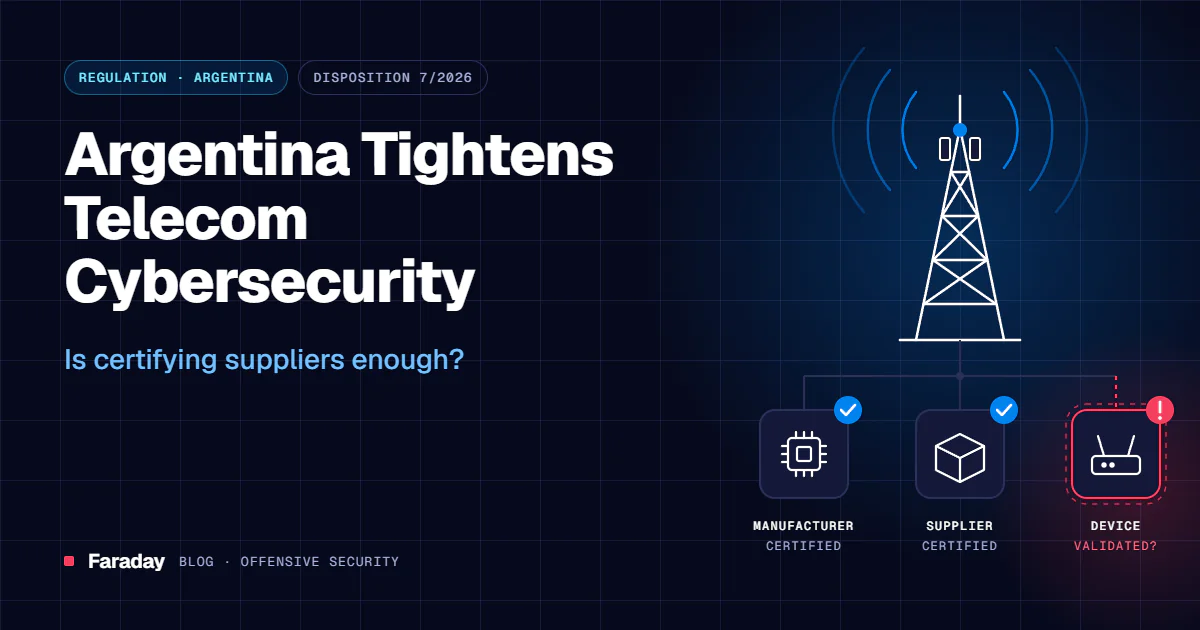
And those risks don’t necessarily go away just because the manufacturer has certified processes.
Certifying how a supplier manages security is not the same as proving that every deployed device, configuration or system is protected against an attack.
In fact, the regulation itself distinguishes between supply chain security management schemes and technical product evaluation mechanisms.
The two serve different purposes and can complement each other.
From compliance to continuous security validation
Infrastructure can meet procurement requirements and still develop new vulnerabilities once it’s in operation.
Threats evolve, new CVEs are published, configurations change and new components reshape the attack surface.
That’s why security shouldn’t be treated as a point-in-time assessment.
It takes a continuous process that answers concrete questions:
- Which assets and components make up our infrastructure?
- Which known vulnerabilities could affect them?
- Which ones pose a real risk to operations?
- How exposed are our systems to an attacker?
- How do we verify that identified vulnerabilities were actually fixed?
Answering these questions requires combining visibility, technical assessment, prioritization and remediation tracking.
That’s exactly where offensive security brings a different perspective.
Think like an attacker to understand real risk
Attackers don’t judge an infrastructure by its suppliers’ certifications.
They look for entry points, vulnerabilities, weak configurations and opportunities to move through an environment.
Offensive security analyzes systems from that same perspective, in a controlled and authorized way, to find weaknesses before they can be exploited.
Security assessments, pentesting and continuous exposure management complement preventive controls with technical evidence.
This matters even more in critical infrastructure. There, a vulnerability can compromise not only technology systems but also the availability and continuity of essential services.
In these environments, testing must be designed around operational constraints and availability risks.
From findings to decisions
Finding vulnerabilities is only part of the job.
In complex infrastructures, security teams need to know which risks to tackle first, how to manage remediation and how to verify that the fixes worked.
At Faraday, we combine offensive security expertise, research and technology to help organizations identify, manage and prioritize their risks.
Through our platform and FaradAI, which brings together autonomous pentesting, continuous validation and risk prioritization with the judgment of our experts, we turn technical findings into information that drives better security decisions.
Technology scales assessment and tracking. Expert knowledge provides the context to interpret results and act on the risks that matter.
An effective security posture isn’t built by piling up controls, certifications or reports.
It’s built by understanding the real exposure of your systems and acting on it.
An opportunity to rethink critical infrastructure security
Disposition 7/2026 moves Argentina’s conversation on technology supply chain security forward.
Its implementation and potential extension to the private sector still raise questions, but the challenge it highlights already exists.
Organizations need to understand the risks in the technology they use, assess their exposure and keep validating it throughout their systems’ lifecycle.
Critical infrastructure security doesn’t end when a supplier gets certified. It has to be validated throughout operation.
At Faraday, we believe effective defense starts with understanding how an attacker could act.
How exposed is your infrastructure today?
See how Faraday helps you identify, assess and prioritize risk with offensive security and continuous vulnerability management.
Let’s talk about your exposure
Sources
- National Cybersecurity Center (CNC), Disposition 7/2026, published in Argentina’s Boletín Oficial on November 6, 2026.
- Annex I: Technical Supply Chain Security Requirements for Equipment Used in Critical Telecommunications Infrastructure.
- Mobile Time Latinoamérica, “Argentina impone nuevas exigencias de seguridad para las redes de telecomunicaciones” (in Spanish), November 6, 2026.