Security teams are facing an increasingly difficult challenge: managing growing volumes of vulnerability data while maintaining visibility, prioritization, and operational efficiency.
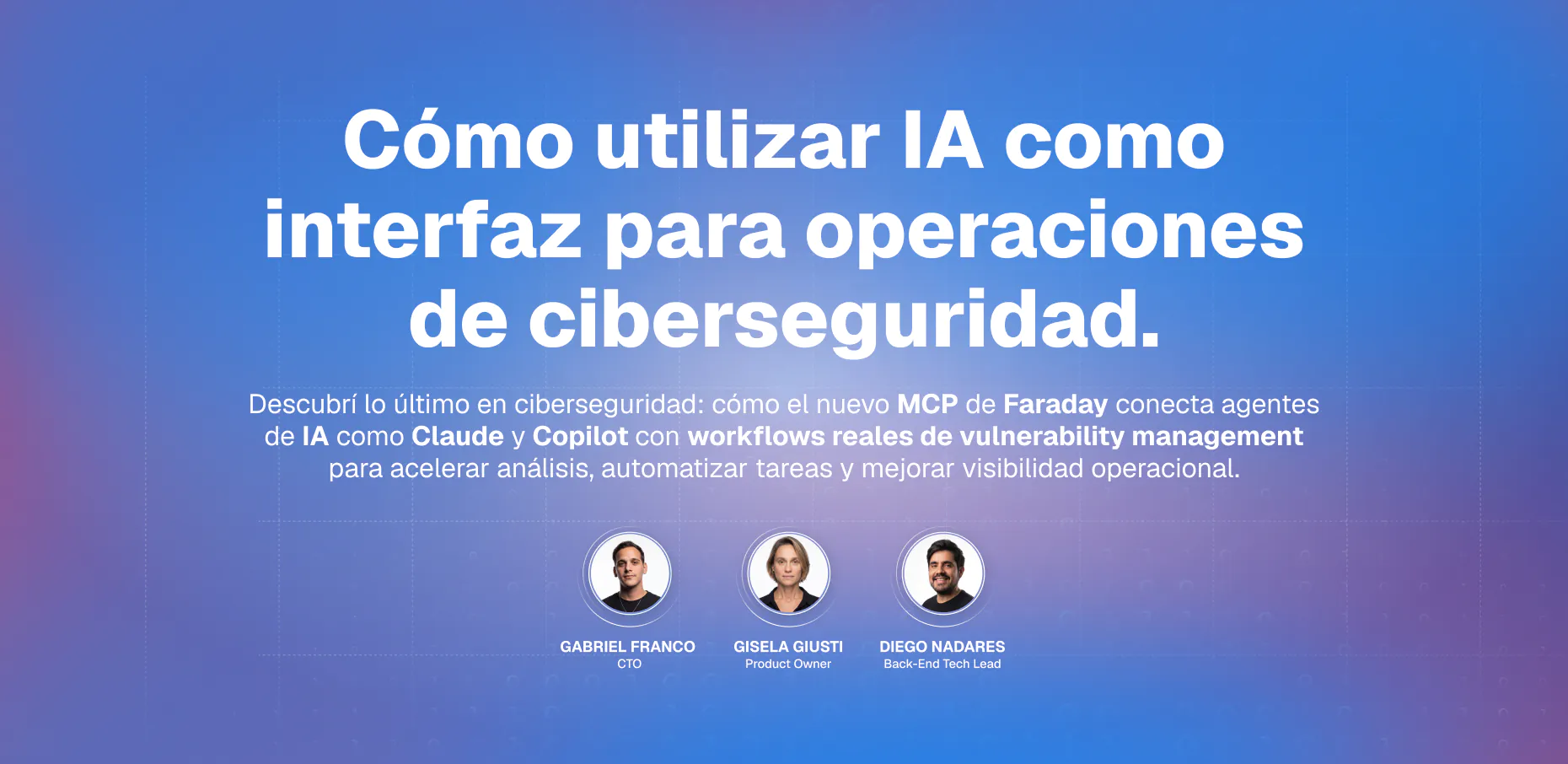
At Faraday’s latest technical webinar, we explored how AI is changing security operations and introduced Faraday MCP (Model Context Protocol), a new way to connect AI agents such as Claude, Copilot, and custom LLMs directly to real Vulnerability Management workflows.
Rather than spending time navigating dashboards, exporting reports, or manually correlating findings, security teams can now interact with vulnerability data using natural language.
What is Faraday MCP?
Faraday MCP is an implementation of the Model Context Protocol that allows organizations to securely connect AI agents to Faraday Platform.
As AI becomes part of everyday security operations, teams need a structured and governed way to provide agents with access to vulnerability data, remediation workflows, asset context, and reporting capabilities.
Faraday MCP enables that interaction while preserving the visibility and control security teams require.
Instead of relying on filters, spreadsheets, and manual analysis, users can ask questions such as:
- Which critical and high vulnerabilities remain open?
- Show me findings with a Risk Score greater than 60.
- Which assets are affected by the same vulnerability across multiple projects?
- Generate a report summarizing critical findings.
- Which vulnerabilities have a known exploit available?
- Which findings remain unresolved after 30 days?
From Vulnerability Data to Operational Context
Traditional vulnerability management platforms are designed around dashboards, tables, and reports.
Faraday MCP introduces a different model: allowing AI agents to understand security context and interact with vulnerability data conversationally.
This enables security teams to:
- Accelerate vulnerability triage.
- Reduce manual reporting efforts.
- Compare findings across workspaces.
- Identify high-priority risks faster.
- Generate executive and technical reports on demand.
- Perform authorized actions directly from natural language requests.
As discussed during the webinar, the objective is not simply to find more vulnerabilities.
The goal is to help security teams understand, prioritize, and remediate risk more efficiently.
“The challenge is no longer finding vulnerabilities. It’s understanding which ones matter and helping teams act faster.”
Real-World Use Cases
AI-Powered Vulnerability Triage
Security teams can quickly identify critical findings, prioritize remediation efforts, and focus attention on vulnerabilities that present the highest business risk.
Automated Security Reporting
Generate executive summaries, technical reports, and workspace-specific vulnerability reviews without manually collecting data.
Cross-Workspace Analysis
Compare findings across multiple projects and identify recurring vulnerabilities, affected assets, and common attack paths.
Security Workflow Automation
AI agents can help update remediation information, organize findings, and support operational processes using natural language instructions.
Why MCP Matters for Security Operations
The introduction of MCP represents more than a product feature.
It reflects a broader shift in how security teams will interact with security platforms in the future.
As organizations adopt AI agents and custom LLMs, they need secure mechanisms to provide those systems with access to operational security data.
Faraday MCP creates that bridge by connecting AI capabilities with real vulnerability management workflows.
The result is faster investigation, improved visibility, reduced operational overhead, and more efficient risk management.
Watch the Webinar
Want to see Faraday MCP in action?
Watch the webinar to learn how security teams can connect AI agents to vulnerability management workflows and accelerate security operations through natural language interaction.
Speakers
Gabriel Franco
CTO – Faraday
Diego Nadares
Back-End Tech Lead – Faraday
Gisela Giusti
Product Owner – Faraday
Request a Demo
Interested in exploring AI-powered Vulnerability Management?
Discover how Faraday MCP enables security teams to investigate, prioritize, report on, and remediate risk using Claude, Copilot, or your preferred LLM.
Request a demo and see how AI-driven security operations can help your team move faster.
More info: https://www.linkedin.com/feed/update/urn:li:activity:7470210464770281472/